|
|
|
|
|
The Sections 1 to 7 of this Paddock Review description were written in late 2004 to early 2005 just before the B2yoR website was first published on the Internet. In the intervening period the approach to the Review used by B2yoR has developed in a number of areas although the core of the methods remains the same.
During this period B2yoR has also been involved with a major project using 'Classical Paddock Review' which uses methods targeted at assessing a horse's wellbeing before a race. The B2yoR approach, although with some overlap areas, is different in that it's aim is to assess and quantify a horse's basic level of ability. Applying the B2yoR methods to fields of unraced and lightly raced horses, which predominate in many 2yo events, will give an edge in analysing a race before it is run and also in specifying the future value of the form.
Therefore the Sections 1-7 could do with an update to reflect the changes and to integrate the knowledge gained from the 'Classical Review' project. But, to do full justice to that brief the rewrite could turn into a major project and perhaps become too prescriptive. One day the 'B2yoR Paddock Review' book will emerge which is where a full update will ultimately lead. In the meantime this article has had some minor edits applied. Nearly all of these have involved small changes to tighten up the sentence structure and to clarify meaning in odd places.
In the Sections 1-7 the only notable change has been in the '50 to 90 Rating System' sub-section. This originally said that B2yoR used a BHA Official Rating (OR) figure of 70 as the baseline for a horse capable of competing to win average quality Open Maidens. Regular readers of the site will know that OR75 is now the figure used. The OR range 70-74 is actually a fascinating subject in it's own right and in Paddock Review an OR71 horse is notably different from an OR74 one although both are likely to be 'Eternal Placer' types unless they fall into a lesser quality maiden. It is worth noting that the BHA's dedicated 2yo Handicapper (Matthew Tester) works to a rating range around 69-71 to land his Median figure on when the Nurseries start in early July. Since this is the 'Average' you will see a large number of horses in the OR65-75 range and probably a reason why intensive study will show up structure that is classifiable down to a 1-2 point range in Review.
To avoid this article turning into a book B2yoR has decided on the following as the interim solution :-
Paddock reviewing refers to assessing the abilities of 2yos by visual inspection at the racecourse. By the use of a well defined system to describe and rate the 2yos as physical specimens it is possible to produce the following information after a single inspection:-
These ratings and descriptions can then be used, both on the day and in future, to provide assessments of a horse's chances in a particular race. Using the paddock review information of all horses in a race is also useful in assessing the quality of a race and its likely future influence.
The other sections in this page give an outline of the system which B2yoR uses for Paddock Review and why it developed. It also, hopefully, makes a strong case that the use of Paddock Review is open to everyone and is not confined to use by a small group of self perpetuating insiders.
The development of the B2yoR system for Paddock Review grew out of two main areas of dissatisfaction with the existing Paddock Review information which was available. The main unsatisfactory items were :
Experience showed that a different approach was needed to assess horses that targeted getting a good understanding of the large factors which affect a horses ability to make an effective athlete. Therefore concentrating on the factors which make up the initial 80%+ of a horse's overall ability. Once you can assess these factors quickly it is then possible to start adding assessments of more detailed factors to see whether they have any identifiable effect. The reverse process of targeting the 10-20% of details and trying to add the basic 80-90% later is going to waste much time and probably lead to disillusionment before getting to the 80% items.
What grew out of this dissatisfaction along with B2yoR's own trial and error experience was a system to assess and rate 2yos targeting the main items that affect a horse's athletic ability. The system defines what factors are important and uses a consistent set of descriptive language and ratings. This means that the success of paddock reviews can be continually reviewed to identify any problems and improve the system.
For example review has shown that B2yoR used to under-rate smaller, but strongly built, 2yos. Also, horses with white feet were often given too high ratings for athleticism because they appear more active. A classic case of reacting to 'go-faster' stripes. Having a defined format and going back to check ratings has enabled these biases and other issues to be identified and corrected.
At the top level the approach can be encapsulated as assessing the factors in the statement at the top of this page :-
"Is that it?" you may well be saying, followed by "there must be more to it than that!". Experience has shown that people expect to be drizzled with conformation details and horsey jargon by those they believe to be 'paddock experts'. But the same experience has shown that this expectation is wrong and you need to avoid getting bogged down in details and jargon and look at the overall framework first.
The details are important when you are buying a horse because you need to assess whether a yearling will survive the training regime and be able to run a reasonable number of times on the racecourse. The big advantage when you are doing paddock review is that the 2yo will already have been through the initial training regime. If they have survived the training and are on the racecourse then they haven't got a defect which will stop them running at all.
Have you ever watched a 2yo race and found yourself frustrated as the odds-on favourite, with a splendid pedigree, from a top trainer gets beaten? That was going to be your banker winner of the day. Have you ever found yourself mouthing "How are you supposed to find that?", as the 2yo race is won by an unconsidered long-shot? Almost certainly the answer is "Yes".
Is there any way to improve your chances of identifying these traps before you fall into them? If you only use form analysis, previous statistics, pedigree analysis, listening to pundits, etc. then, unfortunately, the answer is "No". You will be climbing out of traps for the rest of of your racing and punting career. There is one good way to avoid a lot of the traps - Paddock Review.
There are four major reasons why someone should try their own Paddock Reviewing:-
Let us go back to the example of beaten odds-on favourites and winning long-shots in 2yo races. If you make a point of looking at beaten odds-on favourites, even later in the season if necessary. you will almost certainly see why they struggled to come up to external expectations. Even though they are well related and with a top trainer they will be moderate to average physical types and they were beaten because too much was expected of them. The trainer wasn't incompetent, nothing underhand took place, the horse is simply an average athlete, at best, and the SP was wrong. Despite what some systems suggest and pundits may say a horse's pedigree, connections and sales price do not ensure a better type. These factors are often overbet in the Starting Price Market and lead to unrealistically short SPs.
If you have seen and rated a field of 2yos before a race you will probably find that the long priced winner was among the better physical types. Again, the SP is probably wrong because of external factors, most notably with unfashionable trainers.
Paddock Review will remove the majority of these 'surprises' and offer good betting opportunities as it does so.
This site is advocating ignoring standard 'wisdom' and doing personal research and therefore is not going to say you should do A, then B, then C. Instead it aims to give you the underlying strategy to apply paddock reviewing and the confidence to try. Also, it is advisable to use a simpler description and rating system to start with than the detailed system that B2yoR currently uses. (B2yoR also needs to keep some inside information for itself.)
To explain the B2yoR system the best place to start is by considering the capitalised items in this statement :-
These are suggested as the main areas that someone should target when trying an initial "80-90%" summary of a 2yos physical make-up and likely ability. Remember that each one of these areas interacts with the others to produce the final ability that a horse shows. So that a full Paddock Review involves :-
With experience you should be able to split the 2yos into three initial categories - too small, acceptable, too large (and usually not well developed enough to carry their size). Within the largest group (acceptable) you should prefer bigger horses so long as they have acceptable characteristics in other areas.
The smallest 'acceptable' horses will have limitations on their ability and usually their distance aptitude. Other than in the shortest races (usually 5f) and probably in faster conditions a smaller horse will be outstayed by similar bigger horses.
If you follow human athletics you will probably know that a 60 metre indoor sprint is a very different test from an outdoor 100 metre sprint. The 60m race allow smaller sprinters with fast starts to get a lead early and hang onto it. In the 100m races the bigger runners, with more efficient strides, have a higher top speed of around 28mph compared to 26.5mph and can maintain that top speed for longer. The 100m race therefore allows the bigger runners to overhaul the small, sharp starters between 60-90 metres of the race and be going away at the end. To stretch the analogy a little further it is the same reason in rugby why Jason Robinson can run away from anyone in the first 20 metres of a sprint but will be overhauled by bigger 'speed' players in a length-of-the-field chase.
As with the (SIZE) estimates you should relatively quickly be able to separate horses in three initial categories. Too lightly built, acceptably built and too heavily built (and therefore probably not developed nor strong enough to carry their weight). The main task of reviewing is then to assess the relative merits of the largest ('acceptably built') group who will range from relatively lighter builds to heavier than average builds.
This will develop with experience but the following basic points should be borne in mind. Horses, like humans, can have two types of muscle mixed as part of their bulk. They will have some proportion of what is commonly known as 'fast-twitch' muscle. This is the heavy, well defined muscle associated with sprinters and weight lifters. This muscle type is poorly adapted for long-term, efficient energy usage which is why horses with a high percentage of this type of muscle will be sprinters and not stay longer distances.
The second type of muscle is termed 'slow-twitch' and, as you have probably guessed, is good at long term use of energy but poor at short term and explosive energy release. So horses with a high percentage of slow-twitch muscle will be stayers. Most 2yos will have a mix of these muscle types so it will need experience to categorise them.
A heavily built 2yo which shows enough maturity and development has the capacity to show above average improvement though the season. As a specific example the trainer BA McMahon often has this heavily built sprint type and they can show solid improvement through the season. In the 2004 season both of his representatives (Pivotal Flame and Hidden Jewel) in the Doncaster October Sales race stood out from the rest as the field as more muscular and well prepared sprint types. They finished first and second but, interestingly, Hidden Jewel was 100/1 because he has run four poor races previously.
This was a good example of how Paddock Review 'works well'. If you had looked at the field for that race with no knowledge of form then Hidden Jewel would have been one of the best physical specimens. If you had then been told he had run four poor races rating in the 50s you would have said that he might have another problem, possibly between his ears, because he was better than that as a physical specimen. That he runs well in the race is not a surprise to you, the fact that he's 100/1 would be.
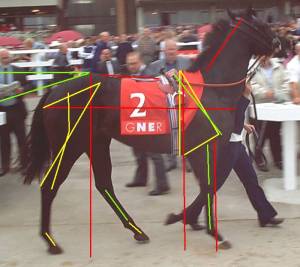
In this area you are looking to describe the overall size and proportions such as the length of body/legs, body depth/width, neck length/shape, etc. There are two main points to note:-
So the results from this area of review is a description of the horse's shape and proportions. with scale ratings for each noted part. This approach has the added advantage of forcing a set routine to work through each area to identify any notable features. Experience has shown that if you end a review with a horse having no points noted, good or bad, then you probably have a solidly competitive horse at it's level. Horses that are 'unremarkable' overall tend to be usable within their ability constraints placed on them by their Size and Build.
This area is probably the most difficult to describe and to lay down solid guidelines. The overall athleticism is assessed by judging the horse's walk, how well it carries itself overall and by watching it moving down to post (if possible).
In judging a horse at the walk it is easiest to spot negative factors rather than positive ones. The starting point is to initially judge how well a horse holds and carries itself. This is affected by other areas such as muscle development, geometry and so forth. You should then be looking for how balanced and fluent a walk is and how 'easily' the horse moves. During this part you should be noting any obvious problems with the movement, for example if it is unbalanced or seems forced.
The usual suggestion is that the walk should be judged by assessing how far the hoof-fall of the hind legs overlaps the hoofprints of the forelegs. The general implication is that the more the overlap the better and lack of overlap indicates a poor mover. This criteria has some useful ideas but cannot be interpreted in this simplistic form. For example, the amount of overlap is affected by the relative length of the horse. You could have a small, compact horse which can have a large overlap because it is so compact but it may be a scratchy, quick actioned and a poor mover because of it's size and build. The alternative can be true where a well made, but relatively lengthy horse may not overlap at all but will still be a good, fluid mover (although almost certainly lacking sprint speed). You will also find horse's with a large overlap but they clearly do not have full control of that movement. This type of weak horse will be a poor athlete and usually very slow.
It is suggested that, as with other areas, you split horses into 3 obviousgroups relating to the hind leg hoof-fall overlap. The groups would be:-
The acceptable group will be the majority of horses and they can then be judged on the more general criteria for judging the walk. There is a subsidiary advantage of at least looking at the amount of overlap in that you will start to recognise different types of mover. For example, you may start to recognise the quick, 'snap' movement of hind legs in sprint types. You will definitely see the longer, slower movements of stayers and will often be able to hear their relative slowness by the classic 'clip-clop' sound.
The issue of Athleticism is considered further in an article on this site on the gaits that the horse uses.
'Togetherness' is another somewhat abstract area in these review summaries but is as important as any of the other areas for overall influence on performance. A horse with good 'Togetherness' can be defined as one that looks in proportion with all of the parts fitting together well and looking balanced. In a system which advocates taking a high level view of horses under review assessing togetherness, both of the horse as a whole and of major 'components' is essential. To use a well know cliché, but an apt one in this case, "if it looks right, it probably is right."
A horse with good 'Togetherness' has the best chance to be able to express the full ability that it's physical type will allow. Conversely, a horse with good points in some areas but does not look balanced and 'right' will be less than the sum of its parts.
B2yoR uses a rating scale between 50 to 90 to assign an expected best performance level rating. Exceptionally poor individuals are occasionally given ratings below 50 and outstanding physical types are, very rarely, rated above 90.
The use of the range between 50 and 90 has been chosen to give some alignment between the rating and the expected 'actual' performance rating of the yearling on the racecourse (as defined by their Official Rating by the BHB (now BHA) 2yo handicapper). This system is still developing and experience has shown that the agreement between review rating and actual performance is best in the 50-74 section of the scale.
If you wish to investigate this further yourself it is suggested you look at fields for nurseries (2yo handicaps) and also older handicappers where the Official Ratings are known. It is relatively easy to see the differences between groups of 50-59, 60-69, 70-79, 80-89 rated horses. For example, taking areas such as (SIZE) and (BUILD) the lower rated groups will obviously show some combination of small size and poor muscle. Experience has shown that the differences between a horse capable of rating 90-95 and one capable of rating 100+ are less obvious and much more subtle. This is probably because a horse capable of rating 90+ is already a well above average physical specimen. There is also the problem that there are far less horses in the 100+ rating band so there are less examples to try to learn from.
B2yoR uses a mimimum rating of 70 as the benchmark of a juvenile that is worth following as a 2yo and OR75 as the level where a horse should be able to compete strongly to win an average quality Open Maiden. Those with ratings between 64-69 may be competitive in selling, claiming and lower quality auction races. In summary:
| Rating Range | Likely Racing Performance |
| 50-59 | Poorest physical specimens. Those rated between 50-55 are likely to be competitive only in the poorest quality races. Those rating between 55-59 may be capable of competing in selling/claiming races. |
| 60-69 | Moderate to just below average physical specimens. Likely to be able to achieve ORs in the 60s (low 70s at best, probably in early season). Better types should be capable of competing well in sellers, claimers, lesser quality auction races and lower quality nurseries off light weights. |
| 70-79 | Average physical specimens and above but not obviously superior runners. Should include those horses capable of competing well in open maidens. Those rated 70-72 likely to be limited to low 70s ratings. Ratings 73-79 will include better types who may get ratings in the 80s by the BHA handicapper. |
| 80-90 | Well above average and superior physical specimens. Should be capable of achieving ratings in the 80s at least. Better types will be capable of 90+ ratings and be part of the relatively small group of superior 2yo runners. |
An example of the use of these performance ratings would be in quickly analysing nursery handicaps. With these performance estimates related to physical abilities available the usual process of form analysis becomes a secondary concern. The first step in looking at the race would be to compare each horse's Official Rating with it's Paddock Review rating. Only those horses whose review rating suggested they could win off that Official Mark or higher are considered for the shortlist. In many races this approach identifies one or two horses and they are rarely the favourites because they are targeting ability to perform at a higher level than the official handicapper believes has already been demonstrated. Races which show no horses with a 'positive' rating can then easily identified as 'tight knit' handicaps probably between horses whose abilities are well known. These are races to avoid betting in for the most part.
[As an aside - note that one of the results of using paddock review is that you can recognise that the Official Handicapper does not place his nursery ratings at the same absolute level in each season. Paddock Review enables certain 'marker' horses to be identified in each seasons' population who are classic examples of certain physical types with known performance rating capabilities. Using these marker horses and the general population of ratings it can be seen that the placement of the Official 2yo ratings on the absolute scale can range by up to 5-10lbs between seasons. This does not effect the results of 2yo handicap races because the relative weights between the 2yos are still correct by the Official Handicapper's system. The placement on the absolute scale of the 2yo population does have an effect on :-
It is worth covering two other areas of paddock review which should be undertaken. The first is to assess the Fitness of each horse and assign a rating to it (a simple 1 to 10 scale is suggested). B2yoR suggests that the primary area to look at to assess fitness is the muscle definition on the horse's buttocks. The consistent application of collecting fitness information will have uses beyond the individual horses. For example it is possible to compare how fit, on average, a trainer's horses are on average. JL Dunlop is a good example of a trainer who has a poor first-time out wins-runs percentage with 2yos although his horses are usually above average fitness on debut. It is probable that the poor debut record is attributable to lack of mental sharpness of the 2yos and the trainer insisting on his 2yos not having a hard race on debut.
The second area to assess is Behaviour. It is suggested that items such as sweating up and coltishness are really details and should only be assessed as part of overall behaviour displayed. In summary, unless a horse's behaviour seems bad enough that it will almost certainly effect it's performance then these minor issues can be ignored. Initially start by assessing behaviour on a Five Point Scale with 3 as 'Average' and nothing to report. Ratings 1-2 can then be negatives visible and 4-5 positive signs. If you note what the positives and negatives you felt you perceived which lead to a non '3' rating for a horse you will be building up a record of factors which you can assess for their usefulness.
All the way through this article the point has been stressed that you need to take the high level view first (the "80%+") before you start worrying about the details. But it is worth finishing this section with an exampleof a detail which is worth investigating because it certainly has a noticeable effect on horse's performances.
An example has been chosen which you can investigate both with on-course paddock review and by watching races on the TV. The issue can be titled "Nodding" and refers to how a horse carries and uses its head and neck when galloping. On-course paddock review will enable you to identify whether a horse's neck and head are in proportion with it's body and how it carries the neck and head.
When watching a race look for how the horse's heads and necks move, especially how rhythmical the movement is. The classic example of excellent use of the head and neck in a metronomic, balanced and smooth way was Choisir on the firm ground at Royal Ascot and Newmarket in 2003.
The head and neck have two effects on performance :-
Some examples of issues to consider :-
|
|
|
|
|
If you have got this far with this page I hope you have got the positive message that Paddock Review works and is something that you are capable of. So it is now up to you to get onto the racecourse and get reviewing.
It is worth reiterating a few points to bolster your confidence if it is needed. Don't allow yourself to think that this is an activity for insiders. We can take the example of Richard Hoiles (TV racing presenter) who seems to have the right approach to paddock review. However he often allows himself to get cowed into saying "he isn't much of a paddock man" despite the fact he usually talks as much sense about paddock review on TV as anyone. It is probably the case that he feels slightly intimidated by more horsey types among the pundits and presenters, given that his background in in accountancy (using concrete numbers & analysing things formally as positives in his favour you could say). But this reaction from him amounts to confusing Horse Welfare/Stable Management knowledge with the capacity to judge athletic ability which are separate activities.
Hoiles gives the impression that he's trying to treat paddock review as an ongoing 'research' which is the correct approach. One of the problems with the existing insider 'mystique' is that it is passed on through the generations but doesn't appear to be based on any proper research. As an aside the same happens in Thoroughbred breeding whereby we do not have any understanding about the inheritance of athletic ability so that insider mystique, fashion and unsubstantiated theories can hold sway.
Your own reviewing starting from a solid base will be more useful than trying to use the historical methods. To encourage you further it is worth remembering that assessing physical types and developing simple pattern matching as part of this is entirely natural to you. You already judge and assess other human beings as physical types and characters every day without even knowing you are doing it. If you were asked to describe a person as a physical type, assess their movement and describe their likely athletic aptitude you would be able to do it naturally.
The same approaches and factors are at work when assessing horses, all you probably lack is the belief to apply them and the experience of having done it.
| VP 1 | VP 2 | VP 3 | VP 4 | VP 5 | Sire VP 1 |
The Virtual Paddock pages present real examples of groups of 2yos which were assembled for races. The pages contain pictures of each of the 2yos and invites you to assess them and put them into particular descriptions. This is a cut-down version of a Paddock Review and clearly you have less information to work with because you a working with single, two dimensional pictures. However, it is interesting to see how successful you can be at assigning the horses to the descriptions with the information available.
To get the correct answer for each of the Virtual Paddocks please send an e-mail request to the B2yor Contact address.
As discussed in the Foreword above this section is not going to be a detailed updating of the B2yoR Paddock Review methods. It is a more general consideration of the topic along with some thoughts on how 'Classical Review' can be used. A good follow on question is how the two types can be integrated.
On updating this article one point that struck B2yoR as an important oversight is that the phrase 'Horse Standardisation' is never used. To understand why the B2yoR approach to Paddock Review can be characterised as such requires a brief detour to define 'Race Standardisation'. The following link goes to a blog by Simon Rowlands which gives a solid summary of the methods involved in that sort of 'Standardisation'. The following bullet points pull out a few quotes from the blog to give a feel for this approach :-
The quotes show a particular response to the 'problem' of dealing with races where established form is not available. Assume that in a 'Closed System' like the races in a 2yo season that some of the races show very similar form each year. Then use that to standardise form levels and ratings by aggregating perceived performance at the 'Race' level. Mr. Rowland goes on in his blog to show how the phrase "..and weight the outcomes appropriately." from the last bullet point above provides a starting point to apply various methods to try to make the standardisation closer to the real ability displayed.
At one level this is all fine but it misses both some fundamental points about how racing works and how a different approach can bypass much of the fiddling about with weightings that are described. Also, because the major handicappers such as Timeform and the BHA's own official 2yo handicapper are using versions of this approach the figures they produce are already available to 'everyone'. How are you going to find an edge in that set-up? If you believe the ratings produced by this approach are flawed to various degrees through a season and mask a lot of the interesting structure in horse's development, as B2yoR does, then what are the alternatives?
The blog lists 'Time' and 'Breeding' analysis as possible approaches to assist with the problem. The first of those is truly useful and the second of very limited value and easily bettered by a different approach. Mr. Rowland hints at a possible way out when he says "When dealing with two-year-old racing, some form of standardisation is almost unavoidable..". The answer to the issue at hand is actually 'Horse Standardisation'.
The B2yoR approach would say that every 2yo race is full of performance quality 'Yardsticks' before it is even run if you go and Paddock Review the horses. Even if you misplace one or two of the field on the ability rating scale on a single review the whole set of Reviews will highlight these when you look at the shape of the actual result. Rather than try to devine what the performance level was by looking at the whole 'Race' in the context of previous years, instead go directly and look at the small number of 'particles' (i.e. the horses) that are interacting to produce the result. Similarly with 'Breeding Analysis. Rather than trying to assess what sort of athlete the horse might be, given the range of abilities and types the parents have produced. Go and look at what type of athlete the horse actually is. What genes it has really inherited and had expressed in it's physical appearance.
The core of this discussion is a similar argument that turns up in many places. Is it better to model how a 'System' is working and what results it is producing by looking at the properties of the fundamental particles or the aggregated behaviour that they demonstrate as they interact? Warm a gas in a box and model what it does by trying to follow individual molecules or calculate the statistical response all the gas treated as a single block will show. If you want to investigate how an Economic Market (and Betting Markets) will develop then should you model the motivations and actions of individual Traders? Or compare the Market state to previous similar situations, the equivalent of 'Market Standardisation'.
The B2yoR argument would be that aggregating at the 'Race' level is too high and hides a lot of Rating structure and variation that can be usefully applied in race analysis. The 'Horse' in this case is not a 'Fundamental Particle' which can be ignored in a statistical approach. The horse is already a large aggregation of performance fundamentals and factors and can be treated as an aggregation level in itself.
To hammer the point home the following should make a 'Race Standardisation' adherent go cold for moment. If it does not then they have not really understood it. Why does the 'Race Standardisation' approach work at all to any level? The answer is that it is the result of adding up the outcomes of countless individual acts of Horse Standardisation. When a Bloodstock Agent or trainer reviews a yearling for purchase they are Paddock Reviewing the horse. When a trainer looks at a horse and decides when to start it's training regime and what work to give it the same review is occuring. When a jockey rides a horse in work and reports back to the trainer about how it moves and what gears it has they are doing a specialised form of Horse Standardisation. One that is not available to most of us or has to be surmised from visual clues at a remove.
When a trainer decides what type and quality of maiden to run a horse in based on all the Horse Standardisation undertaken it is an absolutely key part of the system that Race Standardisation is trying to plug in to. That decision along with the 'Closed System' which means only a relatively small number of horses and races are available each season underlie the success of Race Standardisation to any level. Figures measured in thousands are actually small in this case.
But, when you realise that Horse Standardisation is the real causative factor underlying everything why would you not try to cut out the 'Middle Men'? Go and look at the horses and find some beautiful 'Truths' waiting to be discovered instead.
The outcome of this has been that the Size variable is still recorded but with a simple 1-3 range with most horses in the 2 category of average. How the rating in this area is factored in has also changed. Another simple 1-3 figure is recorded to assess the usable, well controlled, range of movement the horse's Frame allows. This clearly links to the Athleticism factor which is dealt with below. It is an important development given that stride length is believed to be a key distinguishing factor in assessing the expressed performance of the horse in a race.
Build has changed name to Strength/Power to reflect it is about assessing the power available to the horse in the race. Three numbers are recorded including an overall summary of the physique on show and the horses split into a small set of groups by expected distance aptitude types. Again the way that the figures are factored into the final rating has been altered slightly. In summary, not huge changes but adapting the data recorded but in ways that means the new figures can still be directly compared with the existing database of Reviews.
Another area of refinement has been with the Athleticism Top Level factor. This has been renamed Efficiency and is a now a factor whereby issues other then just movement athleticism can be recorded. The change has been very useful although B2yoR would understand if someone's response was that this might appear to be just playing with words.
The issue to grasp is that defining 'Athleticism' is a difficult task. Try reading various efforts at describing it in horses and you will get a variety of approaches and all will fall back on a "..I know it when I see it.." appeal at some point. B2yoR has found that you can escape this bind by replacing questions about perceived Athleticism with ones about Efficiency. Rather than asking someone to assess how 'Athletic' a horse appears instead ask them to assess whether what it does in certain areas is Efficient. It is much easier to assign a meaning to 'Efficiency' and split the assessed factors into at least the normal Below Average, Average and Above Average grades. If your model starts with Powerballs expending energy in races then the Efficiency approach becomes natural.
The horse's movement can still be assessed in some ways under the Efficiency banner but using measurables that are easier to quantify than a vague appeal to Athleticism. Something had to be done in this area because years of collecting data about horse's rear hoof overlap of the front hooves placement had been inconclusive, at best. Therefore, a more structured approach to collecting useful information in this area had to be implemented.
The final point to be noted in this area is not a full change to the Paddock Review method but to comment on a particular area and how it interacts with basic ability estimates. The example given here came out of an e-mail exchange with a reader of the site who was looking for clarification over judging Fitness amongst other things. So part of the reason to mention it here is to encourage the type of questioning involved for those that are interested.
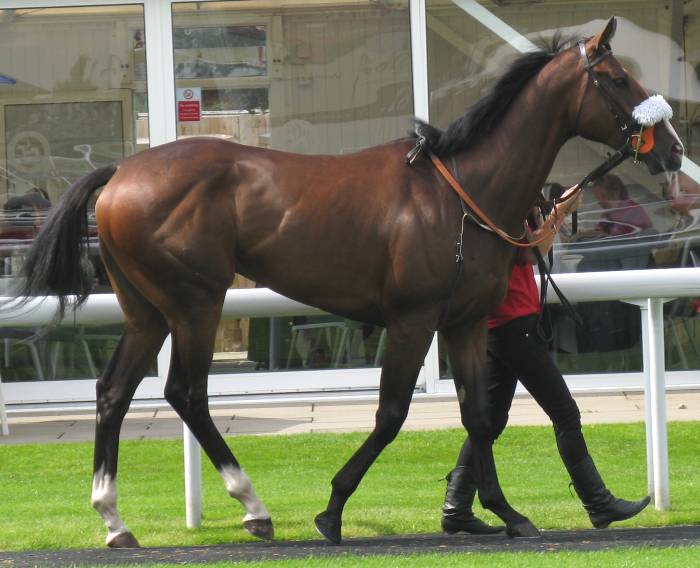
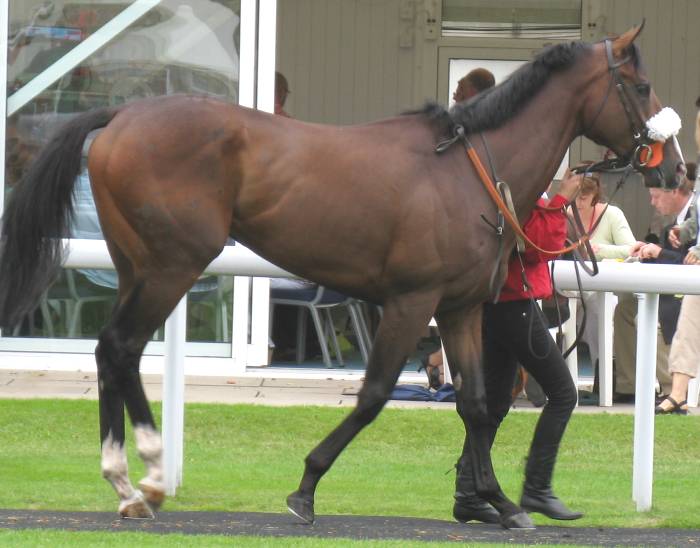
The key point to understand here is that relatively unfit horses do run well and understanding why relates to interesting issues about trainer methods and the career development of the horse. A good example of how Paddock Review can help with a fuller understanding of how racing works. Consider the two pictures below and note that right-clicking on either picture with your mouse should bring up a full size version of the image.
 |
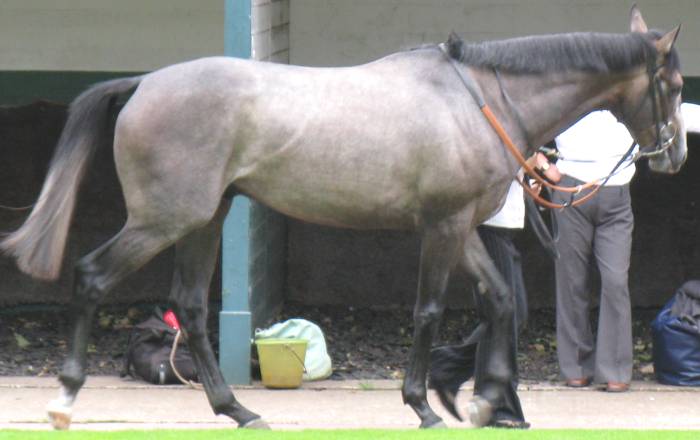 |
The two pictures are from the 2008 season and both horses are on their racecourse debuts. Both have been given Official Ratings well over 100 in their careers but their development followed entirely different paths. Whilst to some extent this was because of their distance requirements and physiques B2yoR would say that the major determinant has been the trainer's they started with and the methods those men use. Swap the two horses over and put them with the other trainer and their careers would almost certainly have been very different.
The picture on the left shows Marine Boy on his Newbury debut which he won by a clear 9 lengths and you can argue he was never as good again as he was on that first run. Look at his picture and see how fit he looks with tight loins and no spare flesh overall. The muscle definition around his buttock is of a level that some trainers never achieve. It is at the level that David Evans would manage with one of his 'hat rack' rabbits after a few runs when he knows the horse is expendable and has to win 'now', if at all. Or perhaps like a Gary Moore trained hurdler when it is a 7yo and had lots of runs and many seasons in training behind it.
When Marine Boy appeared for his second run he already looked to be going 'over the top' and looking too light and with his attitude more lethargic (Picture). Since his startling debut he has run 12 more times and managed a single place. Having been rated OR109 at his 2yo peak he was soundly beaten off OR92 on his only run in 2011. Clearly an example of a high fitness rating being good for one run but needing other factors to be recorded to understand how the horse might perform.
Marine Boy ran for trainer Tom Dascombe and a notable part of his early training career was how he wound horses up for their early runs. They would compete well on these initial runs with their superior fitness but their careers would typically have peaked before the Autumn of their juvenile career had arrived. Those that bought the horses who he had 'hot housed' into 'Black Type' wins and high Official Ratings this way had limited success with them in their later runs and the 'Marine Boy' career path typical.
Now look at the picture on the right which is of Glass Harmonium on his Sandown debut. How does he compare to Marine Boy in terms of fitness? Flabbier all around, little buttock definition and a hint of a 'belly'. You would have to rate him below average on fitness and he finished unplaced. He was only slightly better and tighter on his second run when he won a Yarmouth maiden comfortably. The Official Rating he got for that was OR86 with a portion of that figure pumped in because of his connections.
Why would a trainer as successful as Stoute leave a horse 'underdone' like that at 2yo? The reason is that he is playing a long game of developing a career and not looking for fast returns and impact like Dascombe. Stoute knows this horse is going to be capable of running to well over OR100 as he gets older so he wants a slow start so he gets a usable OR that he can go into handicaps with. In the case of Glass Harmonium he could easily have been one of those 3yo handicappers who wins a big Newmarket handicap in early season off OR86 then another at a major track off an OR90s figure before going in Listed and Group races.
Stoute had left the horse somewhat unfit at 2yo because he did not want his OR110 horse revealing that as a juvenile and limiting his options in winning races. You ensure your high class athlete only runs to a good enough level to win a maiden and gain some experience, and a usable OR, by leaving it underdone. Stoute is clever and experienced enough to know exactly how to prepare a horse to get the job done. A horse like Glass Harmonium might not show up on course as strongly fit until after Royal Ascot of it's 3yo season with Stoute expecting to be able to gradually improve it over 2-3 seasons. If you just look at 'Fitness' without factoring basic ability you will be baffled by the wins for a horse classified as unfit. B2yoR could attest to a number of occasions of watching Classical Reviewer Ken Whatshisname standing in winners' enclosures shaking his head when faced with such a winner. Factor in real ability and the knowledge of how racing works from the B2yoR Paddock Review and things make more sense.
To wrap the story up Glass Harmonium was owned by Ballymacoll Stud who presumably said to Stoute they would rather go for Group races then paddle around mopping up handicaps to start his 3yo season. Rather than running in a handicap he began his 3yo season in April at Newmarket in a Group 3 Guineas trial. During that year he won a Listed race and placed at Group 3 level. The Stoute plan to keep him slowly developing was working though and as a 4yo he managed a Group 3 success and had a go in Group 1 events without placing. As a 5yo he transferred to race in Australia and has won at Grade 1 and 2 level out there although it is difficult to ascertain whether that amounted to an improvement over his British performances.
The final part of this Afterword sub-section will give a small insight the 'Classical Review' project that B2yoR was part of and draw out a few of the the points of interest. The project was funded by a Hong Kong based betting operation who were the largest in the world at that time but were looking to expand into other countries. The total of the 'Pool' that they were betting into in Hong Kong was declining and the percentage of the money in the Pool that was theirs too high.
They set up an operation in Britain and ran a number of projects to see what local data they could collect that could be usefully fed into the computer models they were running to make their bets. Initially this targetted following SP Market moves on-course. But, they had arrived just in time for the 'Betting Ring' in Britain to become mostly empty and a minor player compared to the online betting. Which meant the on-course team were redirected to collect Paddock information. B2yoR was initially involved in the set-up training before working full-time with the project later.
The Hong Kong team used 'Classical Review' successfully in Hong Kong as part of their daily operations and collected data about the typical core of this form of review - Coat Condition, Fitness and Attitude - along with items such as Sweating, Bandages. In the British incarnation they also collected size and build estimates. If you were looking for reasons why the British project eventually was dropped then the fundamental differences between Hong Kong racing and that in Britain would be a major reason. The issues created by the set-up in this country were perhaps not handled fully.
Consider the shape of Hong Kong racing that a Reviewer works in. A horse population of under 1,000 and a lower ratings level in the OR90s so you are looking at better horses. As a general rule B2yoR would say that Classical Review factors show up better with higher class horses. There are only two racetracks and all work is done on the track. One person can assess all the horses all the time or work with another reviewer and they can cover everything fully, doubly. If they happen to want a day off or miss a work session then the local Television channels show daily work programs. Luxury. Easy to build up a Career long set of Reviews of how the horse's condition has developed and changed and to compare that to his expressed form in the relatively small numbers of races run in the country.
How does that compare to Britain? Where the horse population is more than 10,000 and a wide range of abilities. 60 different racecourses spread all across the countries and a large number of races. Seven or eight meetings on a day during the summer with hundreds of horses taking part. The horse's are spread even wider in terms of their training establishments and, with the exception of two or three larger centres, all work is done in private. Come to that environment with your Hong Kong approach of a single person building up an almost daily set of wellbeing reviews and you have some issues to manage to get a successful outcome.
A major issue is how to ensure the team of people you need in Britain do their reviewing to a consistent pattern and produce data that can be merged together. The reviewers will not see horses on every run so will not see the full wellbeing progression themselves. A key part of the Hong Kong model was to "get to know the horse as an individual.." to assist the reviews. This is so that you can have a baseline to judge a horse by. For example, some horses will appear 'Lethargic' in attitude on a first viewing and will be marked as a negative and they will then run very well and perhaps win. The horse isn't lethargic but a 'Quiet Professional' who will always look a bit quiet in general terms and that needs to be factored in.
These issues highlight that a reviewer will need at least two extra levels of support with British racing :-
Given the project did not continue beyond the almost 3 years it ran then you might be able to form a view on whether the above points were managed. B2yoR did it's own research into the consistency of the reviewing including talking through the methods that each participant felt they were implementing. Consider the position with assessing 'Coat Condition' that emerged from this. Here is a full list of the criteria the reviewers felt they were assessing (there should not be a 'List' by the way and certainly not one that people chose their favourite factor from) :-
If we take the example of another major Betting Syndicate who have been sending Reviewers to every British race meeting for more than 10 years how do they solve the issues? You can spot their representatives at a meeting because they will be the reviewers using powerful binoculars even though they are stood relatively close to the horses. They will also be favouring positions that allow head-on views as well. They solve a lot of the consistency issues by constraining tightly the feedback the traders require from the reviewer. Rather than a range of figures across a number of factors these reviewers are required to send back just a single figure for each horse. Unless the figures contain a lot more coding than is apparent then this cannot amount to much more than some version of Good-Ok-Bad classifying. But, it clearly adds value to them and they have built up an impressive database of reviews to compare against performance.
Go back to the Hong Kong project and with one exception all the participants were fully converted to the value of 'Classical Review'. Three went on to carry on doing this reviewing for themselves in various forms after the project finished. B2yoR has done some limited checking on how consistent and worthwhile some of the data collected was for individual reviewers. Removing the issue of merging data from individuals working in different ways. Some interesting patterns show up in this work but it requires a knowledge of how racing in Britain is undertaken and the biases involved to clear away some of the masking factors. Not something a team based in the Far East could accomplish comfortably
B2yoR was a convert to the value of 'Classical Review' but used in Handicaps to sort the field into a version of the Good-Ok-Bad ranking. In fields of lightly raced horses where there is a wider spread of ability and the Official Ratings not known then the B2yoR Paddock Review is clearly better. The 'Classical' approach when done regularly also shows up more general issues which gives insights into the workings of racing. If you see horses regularly then you will see their level of expressed wellbeing change through a season and can compare that to the results they show. Some horses seem to bypass this and look great all the time and the level they run to shows less correlation. Some trainers are very good at getting their horses to look well but still show a progression. Examples will show up where Stables really do come 'into form' with a number of their runners all increasing in wellbeing at the same time.
But, to reiterate, the Classical approach is best used in trying to get an edge with closely matched horses in handicaps. A good example would be a day of big field handicaps at Ascot. Lots of higher class horses involved who show their wellbeing more immediately. Look at the 20+ runner fields as 'Form' and they can seem impossible to make progress with. Forget about form and just do 'Classical Review' and a shortlist of strong contenders will usually present themselves. Good returns resulted from these shortlists over a 3 year period by adding some thought and general knowledge of racing at Ascot such as track biases. An acquaintance of B2yoR, while not a full-time professional and a draughtsman by trade, was a member at Ascot and expected to supplement his wages notably from his betting in tough Ascot handicaps. Press him a little for what he is doing and the answer was a Cross-through-to-3-Ticks system based on Classical Review to produce the shortlist and a spot of 'Powerball' type strength assessment to improve the input. He never looked at the Form Book at all.
To conclude this section let us consider another acquaintance and link his initial approach through to the lightweight world of the TV Pundit. This guy was one of those people that stand somewhere near the One Furlong out pole with a mobile phone talking to an associate who was sat in front of a computer screen ready to trade on Betfair. Finding his edge in the small number of seconds picture delay that most people watch races with yet still feel it is worth them betting 'in running'. A bit of 'inside if wet' since the Racetech picture feeds at the racecourse are still well ahead of the off-course feeds.
Since he was already on the course and at a loose end between races then why not turn himself into a reviewer. Which he did but not before going through the lightweight stage characteristic of the Pundit. The classic symptom of this is the belief in 'Golden Bullets'. This phrase indicating that people expect simple answers when they start and that assessing a single factor will produce strong bets in every race, backing or laying, with little work.
When he started he would regularly ask B2yoR to give him a horse he could lay as soon as the horses came into the pre-parade ring. Then be miffed when the offer was declined with the hint that reviewing was more subtle than that. It was about graft and application to move the balance a bit more in your favour in the long term. At times horses would show up who were clearly not going to perform well but not in every race and it might take a more to assess than looking at a single feature. Initially he thought this was nonsense so used the knowledge he had gained from reading a few pages on the Internet and laid his snap choices anyway. Refreshingly honest, he would always admit he had "done me dough" after nearly all of these efforts which meant that he soon learned from experience and started putting the graft in, to his real credit.
If we turn to the Pundit then, unlike the guy above, they can prattle on about imagined 'Golden Bullets' without doing any of their dough. Instead just carrying on with their lifetime's work of misinforming the racing public and never stopping for a moment to question anything or do a bit of worthwhile research. Let us consider the issue of equine sweating and the Pundit since it has become an item that they seem to think has 'Golden Bullet' pretensions.
The horse in the TV picture has a bit of white froth visible between it's back legs from the rear view. The Pundit scrambling for anything to fill airtime will pick this up and start talking about how it is seen as a negative factor and detrimental to the horse's chances of running well in the race. Here are a few questions to ponder :-
The first bullet point questions should be directed to the Pundits but we could suggest that it isn't based on anything. Instead the usual repeating of hearsay evidence with no underlying basis. The project B2yoR was involved in recorded sweating and the location of it on the horse's body. You could argue that this sort of recording was less prone to the consistency errors that other factors might show. The results of that work did not show any correlations between sweating and performance that you would want to rely on.
The second bullet point opens up a fascinating subject and an area that the Pundit could usefully read up about. The 'White Froth' is not sweat which is mostly a clear liquid and will show up as darker, damp patches on the horse's coat. If the pundit wants to highlight sweating they need to go beyond the visible froth and report on the damp patches between the legs, as well. What is the white froth then?
If you really want to be a geek about answering that question then read the Abstract & Introduction sections in this Research Paper. Consider this quote from the opening lines of the paper :-
Unlike humans, horses have a thick, waterproof, coat of hair. Sweat provides cooling by spreading over skin and then evaporating and removing some of the body's heat as it does so. Without some help the sweat will just drip off the horse's coat and fail to do the job required. To stop this the horse has evolved to produce a protein called Latherin (the clue is in the name) which acts like a detergent and spreads the sweat across the skin. Where the sweaty skin is rubbed by equipment like the saddle and reins it will lather up the protein and show up as the white froth. The muscles between the legs rub against each other to produce the same effect.
When a Pundit highlights a horse at the start with a bit of white froth between it's legs it is just daft. The horse has been involved in physical activity and the muscles have been rubbing against each other as it goes down to the start. Why would there not be some sweaty froth on display? The horse also produces Latherin in it's saliva to assist with grinding down the dry food it eats. Which is why they can also froth from their mouths copiously.
The reason why there might be something to learn from sweating between the legs is that the horse might be producing it in response to a hormonal change and not just to dissapate heat. Perhaps they are getting worked up before the race because of fear or, conversely, because they are too 'up for it' and using up energy before the race. But this is not a 'Golden Bullet'. It will be the case in a few horses and you need to know your horse's normal demeanour. In B2yoR's experience somewhere in the temperature range 15C to 18C all horses, except the odd equine Alistair Cook, will start to sweat to some extent. So in a normal British summers you will be struggling to differentiate even the few horses that the between-the-legs sweating might be an useful indicator in.
Hopefully you will have got the message that this is a tricky subject and looking for easy answers by observing single factors is not a good starting point. One day perhaps we will get some pundits that try to engage with the wider picture. You wonder why they do not since if you want to fill airtime then extending the knowledge and areas you can talk about assists this? Surely.
If you want to believe in 'Golden Bullets' then here are a few ideas of places that might be worth more of a look before spending your life inspecting horses' backsides. On the Positive side then look into 'Dappling' (a B2yoR favourite) and the 'Drivetrain Coil'. The second of those a favourite of the person B2yoR respects most as a Classical Reviewer although a factor that needs some care to judge when the 'Positive Energy' has gone 'Bad'. On the Negative side the closest to 'Golden Bullets' come when judging Behaviour or Attitude. Horse's who are no longer 'with us' and not responding to the handler include several subsets who never win. The 'Gone Inside' and the 'High on Life' types for example. With lightly raced horses then if you can learn to identify very inexperienced ones then they will almost always fail even if there are good physical types. Being inexperienced is very inefficient. Look at some horses in the pre-parade ring and you will just know this thing will stand still when the stalls open and not know what to do.
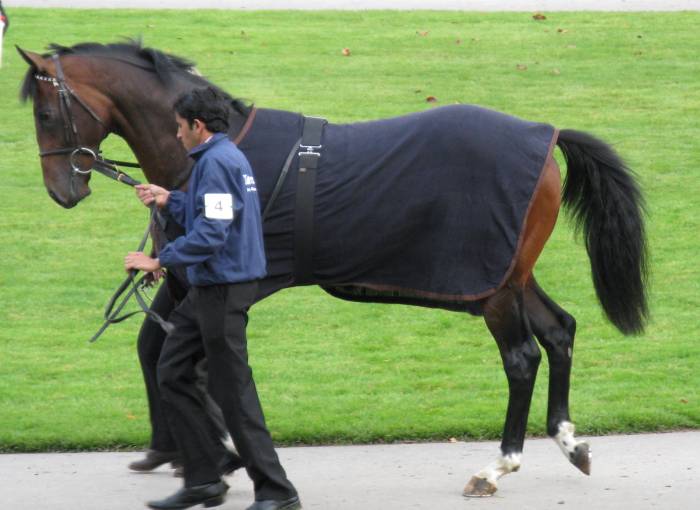
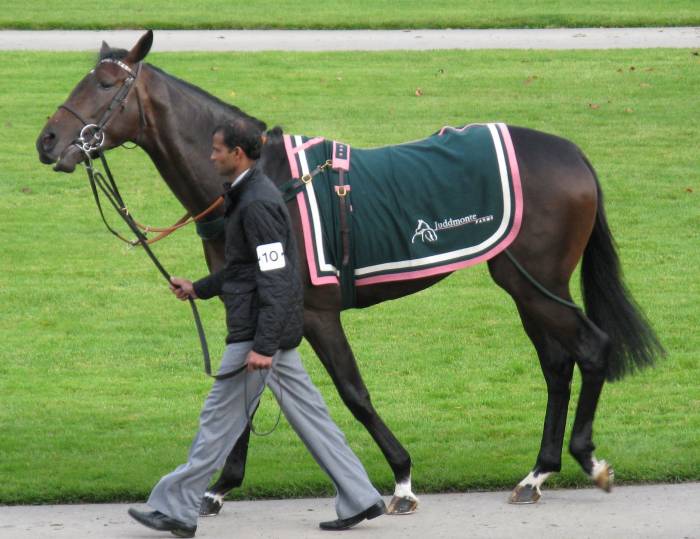
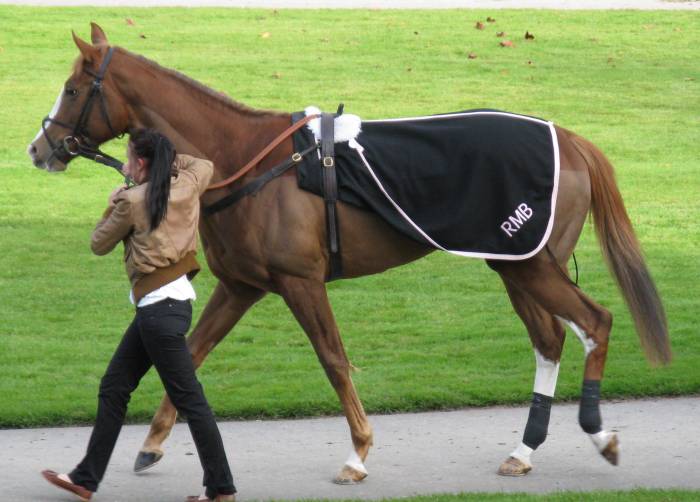
As a lead in to the new Virtual Paddocks try looking at the three pictures below of 2yos on early career visits to racecourse. Which one was the clear winner who responded vigorously to a late challenge by a good quality Godolphin horse and had marched around the parade ring looking businesslike. The other two finished well beaten and both missed the break and needed driving along to get going and were inexperienced in different ways. Both were clueless when asked to make an effort in the last two furlongs and can you spot which one folded completely having been too lively in the preliminaries. Or, alternatively look at them in terms of ranking them for efficient purposefulness.
 |
 |
 |
This Afterword closes with two new Virtual Paddocks for readers to try to solve.
| 2011 - VP 1 | 2011 - VP 2 |